
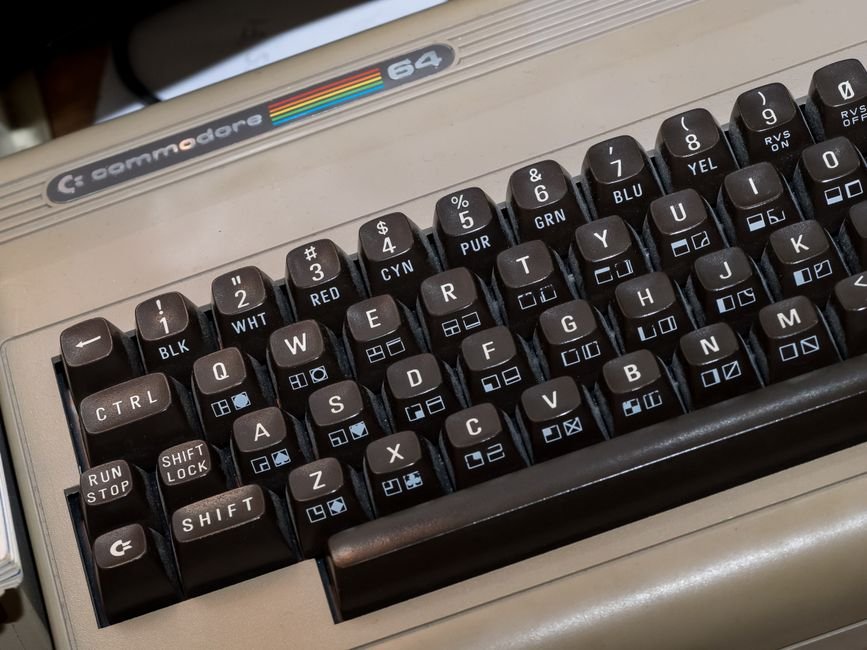
In short: Commodore International was the world’s largest personal computer manufacturer in the 1980s, selling more units than anyone through iconic machines like the Commodore 64 and VIC-20. Internal conflicts, mismanagement, and failure to adapt to IBM PC and Apple competition led to bankruptcy in 1994, erasing a company that once defined home computing.
A company that once outsold IBM and Apple combined no longer exists. Commodore International, at its peak in late 1983, achieved quarterly sales of $49 million—equivalent to $129 million in 2024 dollars—and controlled more of the personal computer market than any competitor on Earth. Fewer than eleven years later, it was bankrupt, liquidated, and erased from the industry it had created.
This is not a story of innovation failing. It is a story of success becoming invisible because the people running the company could not see beyond their own power struggles.
The Birth of Home Computing: Commodore’s First Act (1976–1982)
Jack Tramiel and Irving Gould founded Commodore International in 1976, but the company’s DNA stretched back further. Tramiel had already established Commodore Business Machines in Canada in 1958 alongside Manfred Kapp. That earlier venture had built typewriters and office equipment—unglamorous work that taught Tramiel something crucial: how to manufacture at scale, cheaply, and reliably.
When Tramiel and Gould created Commodore International with headquarters in The Bahamas and executive offices in the United States, they were not entering uncharted territory. The personal computer industry was already stirring. Apple had released the Apple II in 1977. The market was nascent but real. What Commodore possessed that others did not was Tramiel’s manufacturing discipline and a willingness to compete on price rather than prestige.
In 1977, Commodore released the PET—the Personal Electronic Transactor. It was not the first home computer, but it was one of the first to be manufactured reliably and sold affordably. The PET established Commodore’s core strategy: make computers that ordinary people could buy, not just hobbyists or institutions. This was not revolutionary thinking by today’s standards. In 1977, it was radical.
The VIC-20 followed. This machine became the first computer in history to reach one million units sold. One million. In an era when most computers were curiosities, Commodore had created a product that penetrated actual households. Parents bought them for children. Families used them for games and education. The VIC-20 proved that a mass market for home computers existed—and that Commodore knew how to reach it.
By the early 1980s, Commodore was no longer a scrappy challenger. It was a serious manufacturer with distribution, brand recognition, and a track record of execution. The stage was set for the machine that would define the company and, for a time, define home computing itself.
The Commodore 64: The Peak That Looked Permanent (1982–1983)
In 1982, Commodore released the Commodore 64. The name itself was a statement: it had 64 kilobytes of RAM, which was substantial for the era. But the real message was the price. At under $600 at launch and dropping below $300 within two years, the C64 was affordable to middle-class families. It was powerful enough to run serious games and creative software. It was, quite simply, the right machine at the right moment.
The results were staggering. The Commodore 64 became the best-selling personal computer in history. Not best-selling of its generation. Of all time. Millions of units shipped. In the last quarter of 1983 alone, Commodore’s sales reached $49 million. The company had become, by any measure, the world’s largest personal computer manufacturer. IBM was making business machines. Apple was positioning itself as premium. Commodore was making computers that people actually bought.
The C64 was not technically superior to competitors. What it was, was balanced. It had graphics capability that impressed. It had sound synthesis built in—a feature that delighted users and that competitors could not easily replicate. It had a library of software that grew constantly. It had price. Most importantly, it had momentum. Every C64 sold created demand for another, because friends had them, neighbors had them, classmates had them.
In Europe, particularly in West Germany, Commodore machines became ubiquitous by 1989. The company had not just succeeded in the United States; it had exported its formula globally. Retailers stocked Commodore. Developers wrote for Commodore. Children grew up with Commodore. The company appeared to have won the personal computer wars. IBM would focus on business. Apple would remain niche and premium. Commodore would own the mass market.
This appearance was an illusion. Inside the company, the foundation was cracking.
The Turning Point: Success and Sabotage (1984–1985)
At the moment of Commodore’s greatest market dominance, internal conflict began to tear the company apart. Jack Tramiel, the founder and driving force behind Commodore’s strategy, left the company. The departure was not amicable. Tramiel did not simply retire. He went to Atari Corporation, bringing with him knowledge, relationships, and—most importantly—his vision of how to compete in the personal computer market. Employees followed him. The split was not just a management change; it was a schism.
What happened next revealed how fragile even dominant market positions can be when leadership is divided. Commodore, under co-founding chairman Irving Gould and president Mehdi Ali, did not collapse immediately. Instead, the company pivoted. In 1985, Commodore launched the Amiga 1000.
The Amiga was, by the standards of 1985, genuinely advanced. It featured AmigaOS with a full-color graphical interface and preemptive multitasking—capabilities that put it ahead of the Apple Macintosh in raw technical specification. The machine was powerful, flexible, and innovative. It should have been a triumph. For a time, it was. The Amiga became popular in creative industries and among computer enthusiasts. It found particular success in gaming.
But the Amiga’s launch represented a strategic mistake that would prove fatal. The C64 was still selling in enormous quantities. The company still dominated the mass market. Instead of defending and extending that position, Commodore shifted focus to a new, more expensive platform aimed at a different market segment. This was not necessarily wrong—companies do need to innovate and evolve. But the timing, combined with the internal chaos caused by Tramiel’s departure, meant that Commodore was not executing either strategy with full force.
IBM-compatible computers, meanwhile, were improving rapidly. The IBM PC and its clones were becoming cheaper, more powerful, and more standardized. Apple was refining the Macintosh. Both competitors were gaining market share in the segment where Commodore had been strongest. Commodore was looking upmarket toward creative professionals and gamers, leaving the mass market increasingly exposed.
The company that had won through focus and execution was now divided in purpose and leadership.
The Decline: When Market Leadership Evaporates (1986–1993)
From 1986 onward, Commodore’s position deteriorated with surprising speed. The company still sold computers. The Amiga still had fans. But the trajectory had reversed. Market share eroded. Competitors improved. The IBM PC architecture, once considered inferior to Commodore’s technical capabilities, became the industry standard. Software developers prioritized IBM compatibility. Retailers stocked IBM clones more prominently. The network effects that had favored Commodore now favored IBM and its ecosystem.
By 1992, the situation had become dire. The Nintendo Entertainment System and Sega Genesis had established themselves as the dominant gaming platforms. The Amiga, which had found success in gaming, lost that advantage. MS-DOS dominated business computing. The Apple Macintosh, though smaller in market share than IBM compatibles, had established a loyal base in creative industries—precisely the market where the Amiga was supposed to compete.
Commodore was squeezed from every direction. It could not compete with IBM on business computing. It could not compete with Nintendo and Sega on gaming. It could not compete with Apple on creative software. The company that had once owned the mass market now owned nothing in particular. It was a mid-market player in a landscape where dominance belonged to specialists.
The internal conflicts that had begun with Tramiel’s departure never resolved. Irving Gould and Mehdi Ali, running the company, could not chart a clear course. Innovation slowed. Marketing became reactive rather than proactive. The company was managed for survival rather than growth. Survival, as it turned out, was not achievable.
Commodore’s decline was not sudden. It was the slow erosion of a once-dominant position by a company that had lost its sense of purpose. The machines were still competent. The brand still meant something to millions of people. But meaning and competence are not enough if the market has moved on and leadership cannot see it.
The End: Bankruptcy and Liquidation (1994 and Beyond)
On April 29, 1994, Commodore International filed for bankruptcy. The company was liquidated. Assets were auctioned. German company Escom purchased the core assets, including the Amiga intellectual property and manufacturing capability. For a moment, it seemed as though the Amiga might be revived under new ownership. Escom had ambitions. It attempted to develop the platform further and bring new Amiga systems to market.
Escom itself went bankrupt in July 1996. The Amiga assets changed hands again. Gateway 2000 acquired the copyrights and trademarks. The Commodore brand name passed to Tulip Computers of the Netherlands. The brand remained under Dutch ownership until 2025, when a group of investors purchased it and incorporated a new U.S. company called Commodore International. The name persisted, but the company it represented was gone.
What remained was intellectual property scattered across multiple owners, a brand name with nostalgic value but no market presence, and a cautionary tale about how quickly dominance can evaporate. The C64 and Amiga retained cult followings. Enthusiasts continued to develop software for these platforms decades after they were abandoned by their maker. But Commodore International itself—the company that had once outsold everyone—was history.
The liquidation revealed something important: a company is not its technology. The Amiga was arguably superior to contemporary IBM compatibles in several respects. The C64 was not the most powerful computer available. Neither technical superiority nor market dominance guarantees survival. What guarantees survival is the ability to adapt, to execute consistently, and to maintain unity of purpose among leadership.
Commodore had none of these things by 1994. It had only the memory of having had them.
The Lesson: Dominance Is Not Defense (What to Learn)
Commodore International’s rise and fall contains a lesson that extends far beyond computing history. The company did not fail because it made bad products. The C64 and Amiga were good machines, and their popularity decades after discontinuation proves it. Commodore did not fail because the market disappeared. Personal computers became more important, not less. Commodore did not fail because competitors were smarter or more innovative. IBM and Apple had their own struggles and near-death experiences.
Commodore failed because it confused market dominance with competitive advantage. Market dominance is a position. Competitive advantage is a capability. A company can hold a dominant position and still lose its capability to compete. This is what happened at Commodore.
When Jack Tramiel left, he took with him the capability that had built dominance: the ability to see what ordinary customers wanted, to manufacture it affordably and reliably, and to execute that vision consistently. Irving Gould and Mehdi Ali inherited a dominant market position but not the capability that had created it. They managed the position rather than defending the capability. They shifted strategy toward higher-end products rather than defending the mass market. They allowed internal conflict to fester rather than resolving it.
The practical lesson for anyone building or running a business is this: never assume that today’s market position will defend tomorrow’s business. Market position is temporary. It lasts only as long as the capabilities that created it remain sharp and focused. The moment leadership becomes distracted by internal politics, the moment strategy becomes unclear, the moment execution becomes inconsistent—that is when competitors begin to move. They move slowly at first, barely noticeably. But they move. By the time a company realizes it is losing position, the loss is already substantial.
Commodore’s decline took years, but it was not inevitable. At any point between 1984 and 1992, decisive action could have changed the outcome. A clear strategic choice—either defend the mass market or focus on creative professionals, but not both—could have worked. A resolution of internal conflict and a clear succession of authority could have worked. A commitment to innovation in the Amiga platform could have worked. None of these things happened, because leadership was divided and distracted.
The company that sold more computers than anyone vanished because it stopped doing the things that made it dominant. It is a pattern that has repeated countless times in business history, and it will repeat again. The only defense is vigilance: the constant, deliberate effort to maintain the capabilities that created success, even—especially—when success makes that effort seem unnecessary.
Frequently Asked Questions
When did Commodore International file for bankruptcy?
Commodore filed for bankruptcy on April 29, 1994, after years of internal conflict and declining market share. The company was subsequently liquidated, with assets purchased by German company Escom.
What was Commodore’s best-selling computer?
The Commodore 64, released in 1982, became the world’s best-selling computer of its era. The VIC-20 preceded it as the first computer to reach one million units sold.
Who founded Commodore International?
Jack Tramiel and Irving Gould founded Commodore International in 1976. Tramiel had previously established Commodore Business Machines in Canada in 1958 with Manfred Kapp.
What happened to Commodore’s assets after bankruptcy?
Escom purchased Commodore’s core assets after bankruptcy but went bankrupt itself in 1996. Gateway 2000 then acquired assets including Amiga copyrights, while the Commodore brand eventually passed to Tulip Computers of the Netherlands.