
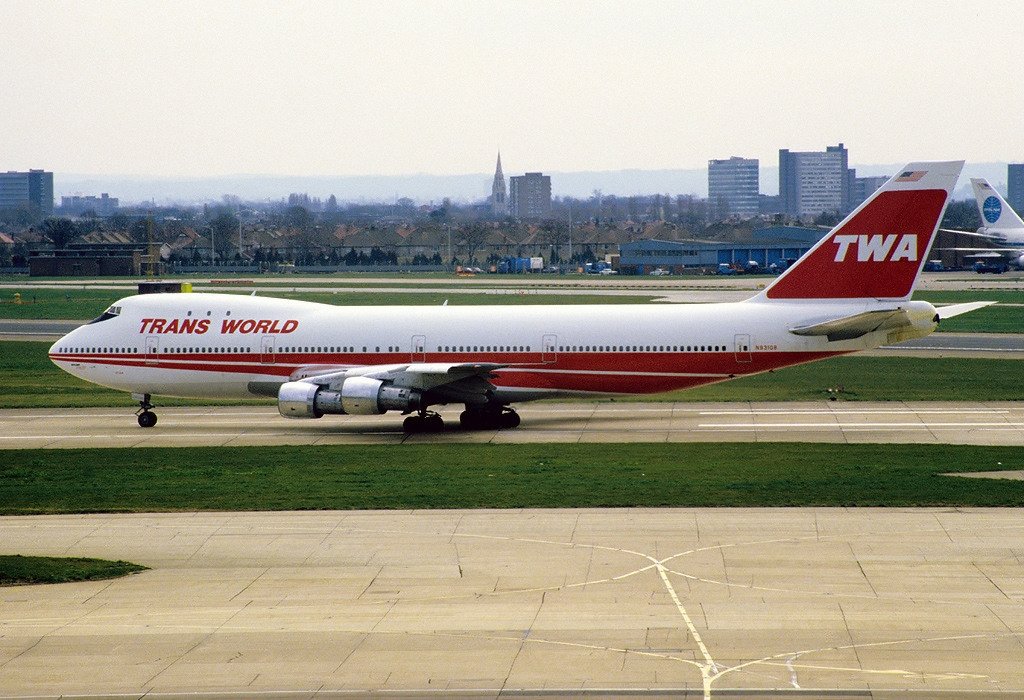
In short: Trans World Airlines rose from a regional carrier in 1930 to a global aviation powerhouse under Howard Hughes, becoming America’s second flag carrier. After Hughes divested in the 1960s, mismanagement, deregulation, debt, and catastrophe—including the 1996 explosion of Flight 800—eroded the airline until American Airlines acquired its remains in 2001.
The Paradox of a Carrier That Owned the Sky and Lost Everything
Trans World Airlines was simultaneously the most ambitious and most fragile of America’s great airlines—a company that commanded routes across three continents, pioneered transatlantic service, and bore the stamp of one of the twentieth century’s most visionary (and destructive) industrialists, yet collapsed into irrelevance within a single generation. By 2001, TWA was gone. American Airlines absorbed its skeleton. The name that once meant innovation and reach meant nothing.
This is not a story about bad luck. It is a story about the collision of deregulation, debt, arrogance, and the specific catastrophe of being owned by men who saw airlines as chess pieces rather than operating businesses. To understand why TWA failed when United and American survived—and thrived—is to understand why some empires are built on sand.
The failure of TWA offers a hard lesson about the difference between expansion and sustainability, between the vision of a billionaire and the discipline of a manager, and between the moment when a company stops adapting and starts defending. That moment came in 1978. Everything after was epilogue.
The Rise: From Regional Carrier to Global Powerhouse (1930–1960)
TWA began not as a vision but as a piece of industrial machinery. The Spoils Conference of 1930 carved up American aviation like a territory treaty. The government awarded route certificates to four trunk carriers—American, United, Eastern, and Transcontinental & Western Air (TWA)—and locked out competitors. TWA’s assignment was the transcontinental route: New York to Los Angeles via St. Louis and Kansas City, initially flown with Ford Trimotors.
For a decade, TWA was respectable but unremarkable. It was a regional powerhouse, not a global player. That changed in 1939 when Howard Hughes began accumulating TWA stock. By 1944, Hughes held controlling interest. What followed was not management in the conventional sense. It was obsession.
Hughes did not run TWA the way railroad barons ran railroads or steel magnates ran mills. He treated the airline as an instrument of his will and his vision of American technological supremacy. He invested heavily in the newest aircraft. He pursued routes that other carriers considered unprofitable. He built TWA into a genuine competitor to Pan American Airways, which had dominated international aviation since the 1930s.
After World War II, Hughes expanded TWA to serve Europe, the Middle East, and Asia. The airline became, in effect, America’s second flag carrier. This was not accidental. Hughes believed TWA should project American power and prestige. The company operated the Lockheed Constellation, one of the most advanced aircraft of its era. TWA pioneered the first nonstop New York-to-London service. By the 1950s, TWA carried more transatlantic passengers than any other airline.
The architecture of this success was Hughes’s willingness to spend money that other airline operators would not spend. He modernized the fleet constantly. He hired top pilots and engineers. He invested in ground infrastructure. And he was willing to operate routes at a loss if they served his larger strategic vision of making TWA a truly global carrier.
By 1960, TWA was one of the world’s great airlines. It was profitable. It was prestigious. It was growing. And it was entirely dependent on the judgment and capital of a man who was becoming increasingly erratic.
The Peak and the Pivot: When Hughes Let Go (1960–1978)
In the 1960s, Hughes divested from TWA. The reasons were partly financial—he needed liquidity for his other ventures—and partly personal. Hughes was becoming more isolated, more suspicious, more consumed by his own obsessions. He ceased to be an active manager. He became a shareholder who occasionally interfered.
New management took control. This should have been a moment of maturation, when TWA transitioned from a billionaire’s vanity project to a professionally managed airline. Instead, it was a moment of strategic confusion.
The new leadership attempted to diversify TWA beyond aviation. The company acquired Hilton International and Century 21, the real estate franchise. The logic was sound on paper: reduce dependence on a volatile industry, generate cash from hotels and real estate. In practice, it scattered focus. TWA was no longer primarily an airline company. It was a holding company with an airline division.
This diversification was not inherently fatal. It was a reasonable response to the uncertainty of the airline industry in the 1960s. But it meant that when the industry faced its greatest disruption—deregulation—TWA’s management was divided in attention and commitment. The company that had pioneered transatlantic service was now managing real estate portfolios.
Meanwhile, the regulatory environment that had protected TWA since 1930 was beginning to crack. Route certificates were no longer guaranteed. Pricing was no longer controlled. The government was beginning to ask whether the airline industry should be left to the market.
In 1978, the Airline Deregulation Act passed. For TWA, it was the beginning of the end.
The Turning Point: Deregulation and the First Crisis (1978–1988)
Deregulation destroyed the protected market that had sustained TWA for nearly fifty years. Suddenly, airlines could fly any route they wanted. They could set their own prices. They could enter and exit markets at will. The result was chaos—and opportunity for the ruthless.
For a company like TWA, which had built its business model on the assumption of stable, regulated routes and predictable pricing, deregulation was catastrophic. The airline industry fragmented. New carriers entered the market. Established carriers slashed prices to compete. Profit margins evaporated.
TWA was particularly vulnerable because its cost structure was high. It had inherited expensive labor agreements. Its fleet was aging. Its routes, while extensive, were not as efficient as they might have been. When prices fell, TWA could not fall as fast. When new competitors entered its markets, TWA could not match their costs.
In 1984, TWA was spun off from its holding company. The real estate and hotel businesses were separated. The airline was supposed to focus on what it did best. But focus required capital, and capital was scarce.
Then Carl Icahn arrived.
Icahn was a corporate raider at the height of his power in the 1980s. He acquired companies, stripped assets, cut costs, and either sold them or took them private. In 1988, he acquired control of TWA through a leveraged buyout. This meant he bought the company with borrowed money, using the company’s own assets as collateral.
On paper, this was a financial engineering triumph. In reality, it was a sentence of death.
Icahn loaded TWA with debt. The airline had to service this debt immediately. There was no grace period. Every dollar that might have gone to fleet modernization, to route development, to employee retention, went instead to debt service. TWA became a company that existed to pay interest on borrowed money, not to operate an airline.
Icahn cut costs aggressively. He negotiated wage reductions with unions. He deferred maintenance. He sold profitable routes to generate cash for debt payments. He sold TWA’s London routes—some of the most valuable assets the airline owned—because he needed the money immediately.
For a few years, this strategy worked. Icahn extracted cash from TWA and enriched himself. But the airline was hollowing out. Its competitive position was weakening. Its employees were demoralized. And the debt burden was growing, not shrinking.
The Collapse: Bankruptcy, Disaster, and the Final Blow (1992–2001)
In 1992, TWA filed for Chapter 11 bankruptcy. This was not a surprise. The airline had been insolvent on a cash-flow basis for years. Bankruptcy allowed TWA to restructure its debt, reduce its obligations, and theoretically emerge as a viable competitor. The airline continued to operate under bankruptcy protection.
In 1995, TWA filed for bankruptcy again. The first restructuring had not worked. Costs remained too high. Revenue remained too low. The debt burden remained too heavy. The airline was trapped in a cycle: it could not cut costs enough to become profitable, but it could not raise prices enough to cover its costs, because the market was too competitive.
Then, on July 17, 1996, TWA Flight 800 exploded off the coast of Long Island. All 230 people aboard were killed. It was the third deadliest aviation accident in U.S. history.
The cause of the explosion was later determined to be a mechanical failure, not terrorism. But in the moment, the disaster was catastrophic for TWA’s reputation. The airline that had pioneered transatlantic service, that had carried presidents and celebrities, that had defined American aviation excellence, was now associated with mass death.
Passengers fled to competitors. Bookings collapsed. Revenue fell. The airline’s financial position, already dire, became hopeless. TWA limped through the late 1990s, sustained partly by bankruptcy protections and partly by the hope that the airline industry would recover.
Then came September 11, 2001. The terrorist attacks devastated the entire airline industry. Bookings evaporated. Fuel prices spiked. The industry contracted overnight. For a weak airline like TWA, already burdened with debt and damaged by Flight 800, the attacks were fatal.
In January 2001, TWA filed for bankruptcy for the third and final time. The company was insolvent and could not be restructured. American Airlines acquired TWA’s assets. American laid off many former TWA employees in the wake of the September 11 attacks. TWA continued to exist as a legal entity under American Airlines until July 1, 2003, when it was formally dissolved.
American Airlines closed TWA’s St. Louis hub in 2009. The last vestige of the airline that had once rivaled Pan American Airways disappeared.
The Lesson: Why Vision Without Discipline Fails
TWA’s collapse was not inevitable. United and American survived deregulation and thrived. Delta survived. Southwest emerged as a powerhouse. The airline industry did not kill TWA. Decisions killed TWA.
The first decision was Hughes’s diversification strategy in the 1960s. By turning TWA into a holding company, the airline’s leadership diluted focus and scattered capital. When the industry faced its greatest test, TWA’s management was divided.
The second decision was the acceptance of Carl Icahn’s leveraged buyout in 1988. This decision prioritized short-term cash extraction over long-term viability. It loaded the airline with debt that it could never service from operations. It ensured that every strategic decision would be constrained by the need to service debt, not by the logic of building a competitive airline.
The third decision was the failure to exit the market earlier. By 1995, it was clear that TWA could not compete. The airline was insolvent, burdened with debt, and losing market share. A rational decision-maker would have recognized that the airline could not be saved and would have liquidated assets to minimize losses. Instead, TWA limped forward, burning cash, hoping for a recovery that never came.
These were not failures of the market. They were failures of judgment.
For a business leader, the lesson is clear: expansion without discipline fails. Vision without financial constraint fails. Debt-financed acquisition fails when the acquired company cannot generate sufficient cash to service the debt. A company that cannot adapt to its competitive environment will not survive, no matter how storied its past or how advanced its assets.
TWA had the routes, the aircraft, the brand, and the employees to survive deregulation. What it lacked was the discipline to make hard decisions early, the willingness to restructure before crisis forced restructuring, and the honesty to recognize when a business model had become unviable.
The concrete lesson: when your business model is disrupted—whether by deregulation, technology, or competition—you have a narrow window to adapt. You must cut costs, exit unprofitable markets, and rebuild your competitive position before debt and loss of confidence make adaptation impossible. The companies that survive disruption are not the ones with the best past. They are the ones with the best present and the most realistic view of the future.
TWA had the best past in aviation. It had the worst present by 1995. It never recovered.
Frequently Asked Questions
When did TWA go out of business?
TWA filed for its third and final bankruptcy in January 2001 and was acquired by American Airlines. The airline ceased to exist as a separate entity on July 1, 2003, when American Airlines closed all remaining TWA operations.
Who owned TWA before it failed?
Howard Hughes controlled TWA from 1944 through the 1960s, transforming it into a global carrier. Carl Icahn later acquired control in 1988 through a leveraged buyout, which burdened the airline with crushing debt that accelerated its decline.
What was the biggest problem that destroyed TWA?
Multiple crises converged: airline deregulation in 1978 eliminated pricing controls, Carl Icahn’s debt-heavy buyout in 1988 starved the airline of capital, the 1996 explosion of Flight 800 damaged its reputation, and the 2001 terrorist attacks finished it off.
What was TWA’s most famous hub?
TWA’s largest hub was St. Louis Lambert International Airport. Its most iconic facility was the TWA Flight Center at JFK Airport in New York, an architectural masterpiece designed by Eero Saarinen and completed in 1962.