
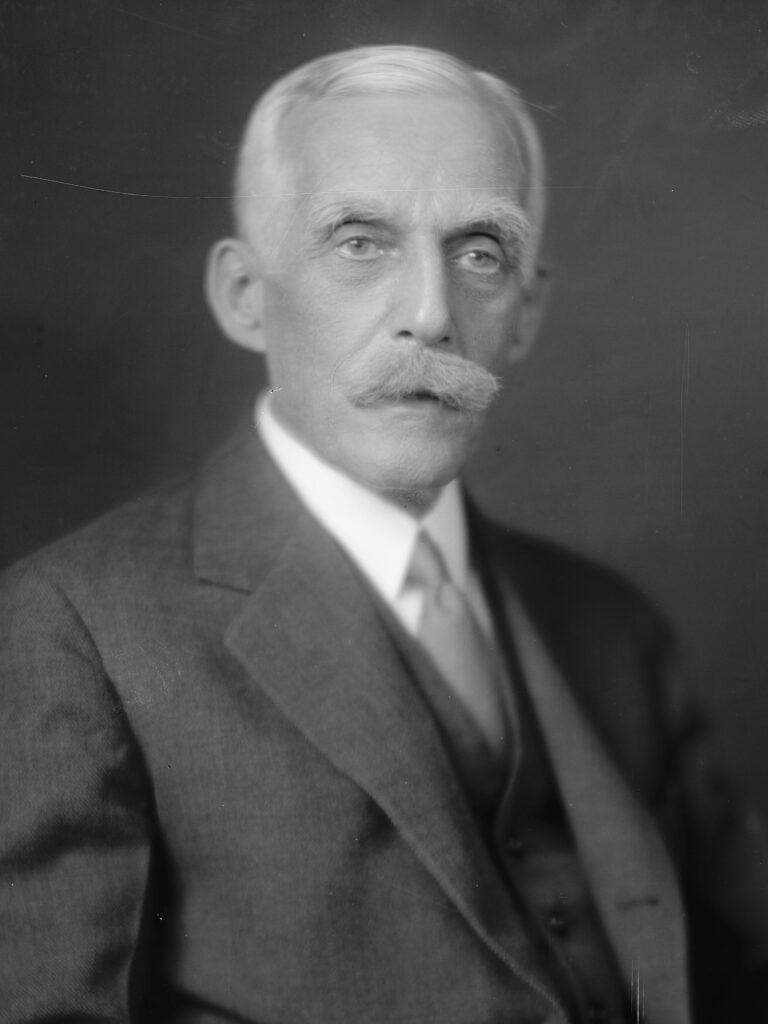
In short: Andrew Mellon controlled American industry not through visible empire-building but through quiet financial architecture—as Treasury Secretary from 1921 to 1932, he shaped tax policy, funded industrial giants, and dominated three presidencies until the 1929 crash exposed the fragility of his vision. His real power lay in understanding that whoever controls credit controls nations.
Andrew Mellon was simultaneously one of the most powerful and most invisible figures in American history. While other titans of industry built visible empires—Rockefeller in oil, Carnegie in steel, Ford in automobiles—Mellon built something more durable: a financial architecture that made him richer and more influential than any of them, yet left him virtually unknown to the average American. By the time most people heard his name, his power had already collapsed.
The Quiet Rise: From Family Bank to Industrial Kingpin
Thomas Mellon, Andrew’s father, built the foundation. In 1870, he established T. Mellon & Sons, a private bank in Pittsburgh, Pennsylvania. But where Thomas laid the groundwork, Andrew transformed it into something unprecedented. Beginning work at the bank in the early 1870s, Andrew Mellon demonstrated an instinctive understanding of how financial leverage works—not as a tool for personal wealth, but as a mechanism for controlling entire industries.
By the 1880s and 1890s, Mellon had grasped something his competitors missed: the banker who controls credit controls the industrialist. He didn’t need to own every company. He needed to own the debt. When the Union Trust Company was established in Pittsburgh in 1889, Mellon had created a second financial institution that gave him dual platforms for influence. By the end of 1913, Mellon National Bank held more deposits than any other bank in Pittsburgh. Union Trust controlled the second-largest bank in the region. This wasn’t competition—it was consolidation of power through structural design.
What made Mellon’s approach revolutionary was his willingness to think in decades rather than quarters. While other bankers made short-term loans and extracted immediate profits, Mellon invested in industrial futures. He financed the Aluminum Company of America—Alcoa—in its infancy, understanding that aluminum would become essential to modern manufacturing. He invested in Gulf Oil when petroleum was still being discovered, not mined. He backed Westinghouse Electric Corporation, Standard Steel Car Company, the Pittsburgh Coal Company, and the Carborundum Company. He even financed the New York Shipbuilding Corporation, extending his reach beyond Pittsburgh into the national industrial base.
By 1913, before he ever held a single government position, Andrew Mellon had become one of the richest men in America and the invisible hand guiding the direction of American industrial development. He wasn’t famous. He was something more valuable: he was necessary. Every major industrial concern in the country had some connection to Mellon capital. He had built not an empire but a network—and networks are far harder to attack than empires.
The Peak: Treasury Secretary and the Roaring Twenties
When Warren G. Harding won the presidency in 1920, he understood one fundamental truth about American politics: the man who controls the Treasury controls the nation. Harding chose Andrew Mellon as Secretary of the Treasury, and on March 9, 1921, Mellon entered the government with a clear mandate: restructure American finances in the aftermath of World War I.
What Mellon found was a nation drowning in debt. World War I had cost America enormous sums, and the federal government had financed the war through taxation and borrowing. The national debt stood at historically unprecedented levels. Income taxes had been raised to fund the war effort. Mellon’s task was to reduce both the debt and the tax burden—but his real mission was to reshape the relationship between government and finance in ways that would benefit men like himself.
Mellon’s economic philosophy was straightforward and radical: cutting tax rates on top earners would generate more tax revenue for the government. This wasn’t a theory—it was a conviction. He argued that high earners, when taxed at lower rates, would invest more capital into business expansion, creating economic growth that would ultimately produce larger total tax revenues despite lower rates. This idea, which would later be called “supply-side economics,” was Mellon’s core contribution to American policy.
The Revenue Act of 1921 and the Revenue Act of 1924 enacted some of Mellon’s proposals, but it wasn’t until the Revenue Act of 1926 that his vision was fully realized. By 1926, the top marginal income tax rate had been cut dramatically from wartime levels. Capital gains were taxed at preferential rates. Corporate taxes were restructured to benefit reinvestment. The effect was immediate and intoxicating: the 1920s roared. Stock prices climbed. Industrial production expanded. Unemployment fell. Credit flowed freely.
And Mellon’s position grew even more powerful. Journalist William Allen White, observing the Coolidge administration at its peak, noted that “so completely did Andrew Mellon dominate the White House in the days when the Coolidge administration was at its zenith that it would be fair to call the administration the reign of Coolidge and Mellon.” Mellon wasn’t just the Treasury Secretary. He had become the de facto economic dictator of the United States. Presidents consulted him. Congress deferred to him. Bankers and industrialists followed his lead.
During the 1920s, the national debt did fall substantially—Mellon had achieved that goal. But something else was happening beneath the surface. The tax cuts had created enormous wealth concentration. The stock market was rising not on the basis of actual earnings but on speculation and leverage. Credit was expanding at unsustainable rates. The banking system was becoming increasingly fragile. Most critically, the prosperity of the 1920s was built on a foundation of debt and speculation, not on sustainable productivity.
Mellon saw the warning signs. But he was committed to his philosophy: government should not intervene in markets. Markets should be left to correct themselves. When people warned him about stock market excess, he dismissed their concerns. When economists pointed to dangerous levels of speculation, Mellon argued that the market would self-regulate. He had built his entire career on the principle that finance should be free from government interference. He was about to learn why that principle had limits.
The Turning Point: October 1929 and the Collapse of Authority
On October 24 and 29, 1929, the stock market crashed. In two days of trading, billions in wealth evaporated. The crash wasn’t a market correction—it was a financial earthquake. And when the dust settled, it became clear that Andrew Mellon’s entire worldview had been built on sand.
Mellon had believed that markets self-correct. Instead, they had self-destructed. He had believed that lower taxes on wealthy investors would create sustainable growth. Instead, that wealth had been poured into speculation. He had believed that government should not intervene in markets. But the market’s self-correction was leading to economic collapse, mass unemployment, and social chaos.
The Great Depression that followed the crash exposed the fundamental flaw in Mellon’s philosophy: markets can fail catastrophically, and when they do, government intervention isn’t optional—it’s necessary. But Mellon couldn’t accept this. Even as unemployment climbed toward 25 percent, even as banks failed and businesses collapsed, Mellon maintained that the solution was patience and non-intervention. “Liquidate labor, liquidate stocks, liquidate the farmers, liquidate real estate,” Mellon reportedly advised President Hoover. “It will purge the rottenness out of the system.”
But the American people didn’t want purging. They wanted relief. And as Mellon’s influence waned, Congress began moving toward impeachment proceedings against him. The man who had dominated three presidencies was now politically toxic. His philosophy had been tested and found wanting. His reputation, built over decades of quiet power, was collapsing in real time.
President Hoover, recognizing that Mellon had become a political liability, made a strategic decision: he reassigned Mellon to the position of United States Ambassador to the United Kingdom. This move served multiple purposes. It removed Mellon from the center of power. It ended the impeachment proceedings by moving him out of government. And it preserved Mellon’s dignity by giving him a prestigious—if powerless—position. Mellon accepted the reassignment and left for London, his era of dominance over.
The Fall: Exile, Investigation, and the Unraveling of Legacy
When Herbert Hoover lost the 1932 presidential election to Franklin D. Roosevelt, Andrew Mellon’s return to private life was complete. But it was not peaceful. The Roosevelt administration, which had been elected on a platform of aggressive government intervention and wealth redistribution, had Mellon in its sights. Beginning in 1933, the federal government launched a comprehensive tax fraud investigation into Mellon’s financial affairs.
The investigation was high-profile and relentless. Federal prosecutors examined Mellon’s tax returns, his business dealings, his use of corporate structures to minimize tax liability. They were searching for evidence that Mellon had used his position as Treasury Secretary to personally enrich himself, to structure his finances in ways that violated tax law, or to use government power for private gain. The case became a symbol of the Roosevelt administration’s determination to hold the wealthy accountable.
Mellon fought the investigation fiercely, but his political capital was exhausted. The man who had dominated the White House was now defending himself in federal court. The outcome was a settlement: Mellon’s estate agreed to pay significant sums to resolve the tax fraud allegations. It was a humiliation for a man who had spent his entire life accumulating power and wealth. He had been investigated, prosecuted, and forced to pay. His reputation, already damaged by the Depression, was further tarnished.
Yet even in defeat, Mellon retained one thing: his money. The settlement was large, but it did not destroy him. More importantly, Mellon had begun to recognize that his legacy would not be his economic policies or his Treasury tenure. His legacy would be what he built with his wealth outside of government.
The Redemption: Art, Culture, and the Institutions That Endure
In 1937, the year of his death on August 26, Andrew Mellon made a final gift to the nation. He helped establish the National Gallery of Art in Washington, D.C., and donated his personal art collection—one of the most significant private collections in American history—to the gallery. This wasn’t a minor philanthropic gesture. This was Mellon’s attempt to create something that would outlast his economic theories, his Treasury policies, and the Depression that had discredited his philosophy.
Mellon understood something that most titans of industry never grasp: money is temporary, but institutions are permanent. While his tax policies were debated and ultimately rejected, while his economic philosophy was discredited by the Depression, the National Gallery of Art would stand for centuries. While his Treasury tenure was remembered as a failure that preceded economic collapse, the gallery would be remembered as a gift to American culture.
Mellon’s philanthropic legacy extended beyond the National Gallery. His support was instrumental in the later establishment of Carnegie Mellon University, one of the nation’s premier research institutions. His contributions shaped the National Portrait Gallery. While he had failed to control the American economy through financial manipulation and tax policy, he succeeded in shaping American culture through strategic philanthropy.
This was Mellon’s final insight: that true power doesn’t come from controlling markets or dominating presidents. True power comes from building institutions that outlast you. The National Gallery of Art will exist long after Mellon’s tax policies are forgotten. Carnegie Mellon University will train leaders long after the 1920s boom is history. These institutions are Mellon’s real legacy—not the crashed stock market or the discredited Treasury policies, but the enduring cultural institutions that bear his influence.
The Lesson: Power Without Accountability Creates Fragility
Andrew Mellon’s career teaches a paradoxical lesson about power. His greatest strength—his ability to operate outside public scrutiny, to shape policy through quiet influence rather than visible authority—became his greatest vulnerability. Because Mellon’s power was invisible, it was also fragile. When the 1929 crash exposed the flaws in his economic philosophy, there was no public constituency to defend him. He had built power without building legitimacy.
This is the fundamental difference between authority and influence. Authority is visible, accountable, and ultimately resilient because it rests on public consent. Influence is invisible, unaccountable, and fragile because it rests on the assumption that things will continue as they have. When circumstances change, influence evaporates. Authority persists.
Mellon had tremendous influence but little authority. He could shape Treasury policy, but he couldn’t explain or defend that policy to the American people. He could direct industrial investment, but he couldn’t justify that direction to workers whose jobs disappeared when his investment priorities shifted. He could cut taxes on wealthy investors, but he couldn’t convince ordinary Americans that this policy served their interests when the crash came and their savings evaporated.
The practical lesson is this: if you build power through invisible means—through financial networks, through quiet influence over decision-makers, through structural control rather than visible leadership—you are building on sand. True power, the kind that endures, must be built on a foundation of legitimacy. It must be explainable. It must be defensible. It must rest on principles that survive scrutiny.
Mellon’s tax policies might have been sound economic theory. But because they were implemented through Treasury authority rather than democratic debate, because they benefited the wealthy in ways that weren’t transparent to ordinary Americans, they collapsed the moment circumstances changed. If Mellon had built his influence through transparent leadership, through persuasion rather than manipulation, through institutions rather than networks, his legacy might have been different.
Instead, Mellon is remembered as a cautionary tale: the banker who controlled America quietly, who shaped policy from the shadows, who believed that markets would self-correct and that government should never intervene. He was wrong on the facts, and his philosophy was discredited. But more fundamentally, he was wrong about the nature of power itself. Power that cannot be defended in public is power that will not survive public scrutiny. The institutions Mellon built to survive—the National Gallery, Carnegie Mellon University—are the ones that endure. The economic policies he implemented through quiet influence are the ones that are forgotten.
For modern leaders, the lesson is clear: build your power on foundations that can withstand public examination. Make your decisions defensible. Explain your reasoning. Create institutions, not networks. Seek legitimacy, not just influence. Because when the market crashes—and markets do crash—invisible power evaporates. Only visible, defensible, institutionalized authority survives.
Frequently Asked Questions
What made Andrew Mellon so powerful during the 1920s?
Mellon held three sources of power simultaneously: control of Mellon National Bank (Pittsburgh’s largest), ownership stakes in major industrial companies like Alcoa and Gulf Oil, and the position of Treasury Secretary under three consecutive Republican presidents. This combination allowed him to shape both private and public economic policy.
Did Mellon’s tax policies actually work?
During the 1920s, Mellon’s tax cuts on top earners coincided with economic growth and national debt reduction—but this relied on unsustainable speculation and wealth concentration. The 1929 crash revealed these policies had masked fundamental instability rather than created genuine prosperity.
Why did Mellon’s reputation collapse so quickly?
The Wall Street crash of 1929 and the Great Depression that followed discredited Mellon’s hands-off economic philosophy. Congress moved toward impeachment proceedings against him, forcing President Hoover to reassign him as ambassador to the United Kingdom to end the political crisis.
What is Mellon’s lasting legacy?
Beyond his controversial economic policies, Mellon’s philanthropic work—founding the National Gallery of Art and supporting Carnegie Mellon University—shaped American cultural institutions. His career also demonstrates how financial power can rival political power in shaping national direction.