
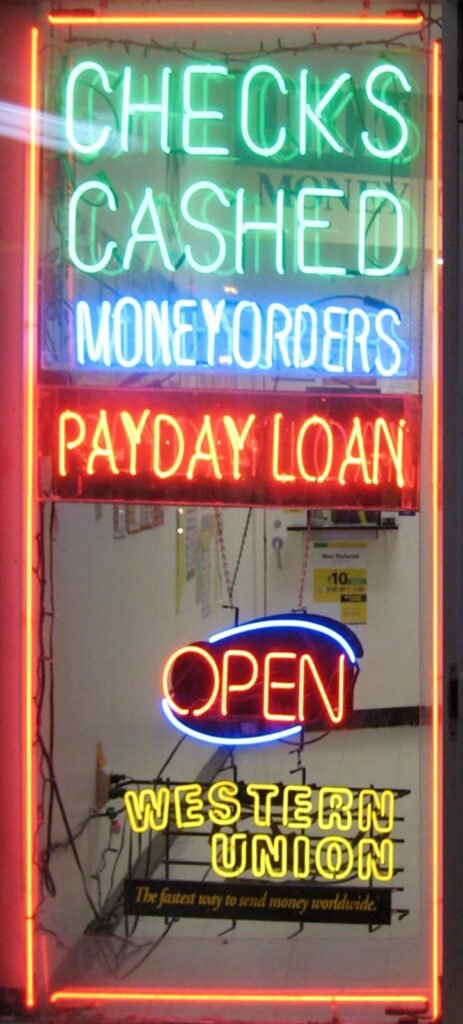
In short: Payday loans charge extremely high interest rates (often 400% APR or more) and are structured to keep borrowers in perpetual debt cycles. Lenders profit not from one-time loans, but from repeat borrowers who cannot repay on time and must roll over their debt, paying fees repeatedly on the same original amount.
The Paradox at the Heart of Payday Lending
Payday loans exist to solve a problem, yet they systematically create the very crisis they claim to prevent. A borrower walks into a storefront or visits a website desperate for immediate cash—perhaps to cover rent, medical bills, or a car repair. The lender offers a solution: borrow now, repay on payday. It sounds straightforward. But the structure of these loans, their pricing, and the business model underlying them ensure that most borrowers who take one payday loan will take many more. The crisis does not end; it deepens.
This is not accidental. It is the foundation of the payday lending industry. Payday lenders do not profit primarily from the borrower who takes one loan and repays it cleanly. They profit from the borrower trapped in a cycle of debt, paying fees repeatedly on money they borrowed months or even years ago. Understanding how this trap works requires examining the mechanics of payday lending, the predatory practices embedded in the business model, and the regulatory landscape that permits these practices to flourish in many jurisdictions.
The payday loan industry has grown into a multibillion-dollar enterprise precisely because it has perfected the art of converting temporary financial hardship into permanent debt servitude. For millions of Americans and borrowers in other countries, a payday loan represents not a bridge to stability but a descent into a financial spiral from which escape becomes increasingly difficult.
How Payday Loans Work: The Mechanics of the Trap
A payday loan begins with simplicity. A borrower, typically facing an urgent expense, visits a payday lender—either a physical storefront or an online platform. The borrower provides proof of income (usually recent pay stubs), a bank account, and identification. The lender approves the loan within hours or minutes. The borrower receives cash immediately, often the same day.
The repayment structure is where the trap begins to close. The borrower must repay the full loan amount plus a fee within a short period, typically two weeks. The fee is not expressed as a simple percentage; it is a flat amount per hundred dollars borrowed. A typical fee might be fifteen to twenty dollars per one hundred dollars borrowed. On the surface, this seems modest. But when annualized, this translates to an annual percentage rate (APR) of roughly four hundred percent or higher—often far exceeding the maximum rates allowed for traditional credit products.
The payday lender typically secures repayment through one of two mechanisms: either the borrower writes a postdated check for the full amount (loan plus fee), which the lender holds and deposits on the due date, or the borrower authorizes an electronic withdrawal from their bank account on the payday. This structure creates an immediate problem for many borrowers. When the two-week period ends, the borrower must repay the full amount in one lump sum. For someone living paycheck to paycheck—the typical payday borrower—this is often impossible.
The borrower faces a choice: default on the loan, damaging their credit and potentially facing legal consequences, or roll over the loan. Rolling over means paying the fee again (typically fifteen to twenty dollars per hundred dollars) to extend the loan another two weeks. The original principal remains unpaid. The borrower now owes not just the original loan but an additional fee on top of it. The cycle has begun.
This rollover mechanism is the engine of the payday lending business model. A borrower who rolls over a loan three times has paid ninety dollars in fees on a five-hundred-dollar loan—an additional eighteen percent of the original amount—without reducing the principal by a single dollar. After six rollovers, the borrower has paid one hundred eighty dollars in fees. After twelve rollovers (six months), three hundred sixty dollars. The original debt remains untouched.
The Business Model: Profit from Desperation
Payday lenders are not in the business of providing short-term credit. They are in the business of extracting maximum revenue from borrowers in financial distress. The data bears this out clearly. Research and regulatory filings show that the majority of payday lender revenue comes not from first-time loans but from repeat borrowers who roll over their loans multiple times.
Consider the economics from the lender’s perspective. A five-hundred-dollar loan with a seventy-five-dollar fee generates a fifteen percent return in two weeks on that single transaction. But if the borrower rolls over the loan ten times over five months, the lender collects seven hundred fifty dollars in fees on the original five-hundred-dollar loan—a one hundred fifty percent return on the principal, not counting any interest earned if the money is held in an account. The lender never has to worry about whether the borrower can afford to repay; the business model depends on the borrower being unable to repay and choosing to roll over instead.
This creates a perverse incentive structure. Payday lenders have no motivation to help borrowers escape debt. They have every motivation to keep borrowers trapped in the rollover cycle. Marketing materials often emphasize the speed and ease of obtaining a loan, but they rarely mention the consequences of rollover or the true cost of the debt. Lenders locate their storefronts in low-income neighborhoods and communities of color, where financial desperation is highest and alternative credit options are limited.
The online payday lending industry has amplified these dynamics. Digital platforms reduce operational costs and allow lenders to target borrowers across state lines, sometimes in jurisdictions where payday lending is restricted or prohibited. The anonymity and speed of online lending also reduce the social friction that might occur in a face-to-face transaction, making it easier for borrowers to take out multiple loans simultaneously from different lenders without realizing the cumulative debt burden they are creating.
Payday lenders have also developed sophisticated data analytics and targeting strategies. They identify borrowers most likely to roll over loans—those with the lowest incomes, the least stable employment, and the fewest alternative financial resources. These borrowers are targeted with aggressive marketing and offered repeat loans before their first loan is even repaid. The industry has optimized itself to identify and exploit financial vulnerability.
The Regulatory Vacuum: Why the Trap Persists
The payday lending industry thrives in a patchwork of inconsistent and often inadequate regulation. Across different countries and jurisdictions, approaches vary dramatically. Some jurisdictions have recognized the predatory nature of payday lending and have restricted or outlawed the practice entirely. Others have implemented rate caps or limits on the number of rollovers a borrower can make. But many jurisdictions have few or no meaningful restrictions on payday lenders, allowing the industry to operate with minimal oversight.
In the United States, regulation is fragmented across federal and state authorities. Some states have implemented strict APR caps, limiting the rates payday lenders can charge. Other states have no rate caps at all, allowing lenders to charge whatever the market will bear. This creates a regulatory arbitrage opportunity: lenders in restrictive states simply move online and target borrowers in less restrictive states or even in other countries. The lack of uniform regulation means that borrowers in permissive jurisdictions bear the full weight of predatory lending practices.
To prevent usury—unreasonable and excessive rates of interest—some jurisdictions have implemented annual percentage rate (APR) limits that apply to all lenders, including payday lenders. These caps serve as a brake on the most egregious practices. However, in jurisdictions without such caps, payday lenders operate with virtually no constraint on the rates they can charge. The result is a two-tiered system where borrowers in protective jurisdictions have some defense against predatory lending, while borrowers in permissive jurisdictions face rates that can exceed four hundred percent APR.
Payday lenders have also exploited regulatory gaps through structural innovation. Some lenders have rebranded themselves as “credit service organizations” or “financial service providers” to avoid payday lending regulations. Others have partnered with banks or credit unions to offer loans that technically fall outside payday lending regulations but function identically to payday loans. These regulatory workarounds extend the reach of predatory lending even in jurisdictions that have attempted to restrict it.
The political influence of the payday lending industry has also shaped the regulatory landscape. Industry groups have lobbied aggressively against rate caps and restrictions, arguing that such measures would reduce access to credit for low-income borrowers. While this argument contains a kernel of truth—some borrowers might prefer a payday loan to no credit at all—it ignores the reality that payday loans often leave borrowers worse off than they were before. The industry has successfully framed regulation as a threat to consumer choice, rather than a necessary protection against predatory practices.
The Human Cost: Default, Desperation, and Downstream Consequences
Payday loans have been linked to higher default rates compared to other forms of consumer credit. This is not surprising given the structure of these loans. A borrower who takes out a payday loan is, by definition, someone who could not access traditional credit or who needed money so urgently that they were willing to accept exploitative terms. These borrowers are more likely to experience income shocks, job loss, or other financial emergencies that make repayment impossible.
When a payday loan goes into default, the consequences cascade through the borrower’s life. The lender may pursue aggressive collection tactics, including threats, harassment, and legal action. Borrowers may face bank overdraft fees when lenders attempt to withdraw funds from accounts with insufficient balance. Court judgments against borrowers can result in wage garnishment, further reducing the borrower’s ability to meet basic needs. Some borrowers, facing the threat of legal action or garnishment, take out additional payday loans from other lenders to pay off the first loan, multiplying their debt burden.
The stress and anxiety associated with payday debt traps can have severe health consequences. Borrowers report increased rates of depression, anxiety, and stress-related illness. The cognitive burden of managing multiple debts and the shame associated with predatory lending can impair decision-making and reduce the borrower’s ability to pursue alternative solutions or escape the debt trap. Some borrowers report that payday debt has contributed to relationship breakdown, job loss, and housing instability.
Payday debt also perpetuates cycles of poverty. When a borrower is forced to spend a large portion of their income servicing payday debt, they have less money available for food, housing, healthcare, and education. Children in households trapped in payday debt cycles experience worse educational outcomes and higher rates of poverty in adulthood. The debt trap does not merely affect the individual borrower; it ripples through families and communities across generations.
For many borrowers, the payday loan trap becomes inescapable without external intervention. Some borrowers remain trapped in the rollover cycle for years, paying thousands of dollars in fees on a loan that was originally a few hundred dollars. Others default, facing legal consequences and damaged credit that makes it even harder to access legitimate credit in the future. The payday loan industry does not solve financial crises; it weaponizes them.
Breaking Free: What Borrowers and Policymakers Must Know
Understanding the payday loan trap is the first step toward avoiding it or escaping it. Borrowers facing financial emergencies must recognize that a payday loan is not a solution; it is a liability that will almost certainly make their situation worse. The short-term relief provided by a payday loan comes at a cost that is often not fully apparent until the borrower is already trapped in the rollover cycle.
For borrowers already trapped in payday debt, several strategies may help. First, recognize that rolling over the loan repeatedly is not a viable long-term strategy. Each rollover increases the total cost of the debt without reducing the principal. Second, explore alternative sources of credit or assistance. Credit unions, nonprofit credit counseling agencies, and community organizations may offer lower-cost loans or financial assistance. Some employers or nonprofits offer emergency financial assistance programs. Local food banks and utility assistance programs can reduce expenses and free up money for debt repayment.
Third, consider negotiating with the payday lender. Some lenders may be willing to work out a payment plan that allows the borrower to repay the debt over a longer period without additional rollover fees. This is not guaranteed, but it is worth attempting. Fourth, seek legal assistance if the lender is engaging in collection tactics that violate consumer protection laws. Many jurisdictions have laws against harassment, threats, and other abusive collection practices. Legal aid organizations can help borrowers understand their rights and defend themselves against illegal collection efforts.
For policymakers, the evidence is clear: payday lending causes more harm than good for the vast majority of borrowers who use it. Effective regulation requires several components. First, states and countries should implement APR caps that limit the rates payday lenders can charge. Research shows that even modest caps do not eliminate access to credit; they simply reduce lender profits. Second, regulators should limit the number of times a loan can be rolled over, preventing the perpetual debt cycles that generate most payday lender revenue. Third, regulators should close the loopholes that allow lenders to rebrand themselves or partner with banks to evade existing regulations.
Fourth, policymakers should invest in alternative financial services for low-income borrowers. Credit unions, community development financial institutions, and nonprofit lenders can provide small loans at reasonable rates to borrowers who cannot access traditional banking services. These alternatives are more expensive than traditional banking but far less expensive than payday loans. Fifth, financial literacy programs can help borrowers understand the true cost of payday loans and recognize the alternatives available to them.
The payday loan trap persists because it is profitable for lenders and because many borrowers, in moments of financial desperation, do not fully understand the consequences of their choices. Breaking the cycle requires both individual awareness and systemic change. Borrowers must recognize the trap for what it is. Policymakers must have the political will to restrict an industry that profits from desperation. And society must commit to building financial systems that serve the needs of low-income borrowers rather than exploiting their vulnerability.
The Lesson: Debt as a Design Feature, Not a Bug
The payday loan industry reveals a fundamental truth about predatory financial systems: they are not designed to fail accidentally. The debt cycles, the high fees, the rollover mechanisms—these are not bugs in the system; they are features. They are deliberately engineered to keep borrowers trapped and extracting maximum value from their desperation.
This lesson extends far beyond payday lending. Across the financial system, there are industries and products designed to exploit information asymmetries, cognitive biases, and financial desperation. Credit card companies design minimum payment structures that encourage consumers to carry balances and pay interest indefinitely. Student loan servicers profit from borrower confusion and default. Predatory mortgage lenders target borrowers they know cannot afford their loans, anticipating default and foreclosure. The common thread is a business model that profits not from solving customer problems but from perpetuating them.
For individual borrowers, the practical lesson is simple but crucial: when evaluating any financial product or service, ask yourself whether the provider profits from your success or from your failure. If the provider profits from your failure—if they make more money when you default, roll over debt, or remain trapped in a cycle—then you should be extremely skeptical of their product. Payday lenders profit when you cannot repay, so they have every incentive to structure their product to ensure you cannot repay. Credit card companies profit when you carry a balance, so they have every incentive to make minimum payments seem reasonable. Student loan servicers profit from default and forbearance, so they have every incentive to keep you confused about your repayment options.
The second practical lesson is to build financial resilience before you need it.
Frequently Asked Questions
What is a payday loan?
A payday loan is a short-term unsecured loan designed to cover immediate financial needs until the borrower’s next paycheck. The borrower typically writes a postdated check or authorizes an electronic withdrawal for repayment. These loans are characterized by high interest rates and short repayment periods, often two weeks.
Why do payday loans have such high interest rates?
Payday lenders justify high rates by citing the risk of default on unsecured short-term loans and operational costs. However, research shows that the high rates primarily serve to maximize lender profits, especially from repeat borrowers who roll over loans and pay fees multiple times on the same debt.
What is loan rollover and why does it happen?
Loan rollover occurs when a borrower cannot repay the full loan on time and instead pays only the fee to extend the loan another two weeks. This traps borrowers in a cycle where they pay fees repeatedly without reducing the principal, sometimes for months or years.
Are payday loans regulated?
Regulation varies significantly by jurisdiction. Some countries and states limit APR rates or restrict payday lending entirely, while others have minimal restrictions. In the United States, regulation is inconsistent across states, allowing predatory practices in some regions while others provide stronger consumer protections.